What Your Body Is Trying to Tell You: A Jungian Approach to Chronic Illness and Mysterious Symptoms
Why do doctors keep telling me there's nothing wrong, when clearly something is?
If you've asked some version of that question, you're not alone, and you're not imagining things. The tests come back normal. The labs are unremarkable. And the exhaustion, the pain, the gut that won't settle, or the symptoms that flare without warning are still, undeniably, there.
There's a framework for understanding this gap—one that takes your symptoms completely seriously while also asking a question conventional medicine rarely has room for: what do your symptoms mean psychologically?
This framework is best illustrated with the case of a client—not a real client of mine, but a hypothetical story, the basic shape of which may ring familiar for many of you. In this hypothetical story, a woman in her early thirties has spent the better part of a year in the kind of conversations couples have when they're circling a decision: whether, and when, to have a child. Around the same time those conversations started in earnest, she began having acute digestive symptoms. What felt at first like a stomach bug never fully resolved; it settled instead into a low-grade, persistent condition that would flare unpredictably for months afterward. She cycled through multiple specialists, an elimination diet, and a folder of inconclusive labs. Somewhere in that process, a doctor mentioned that stress could be "a factor," and she left that appointment feeling worse than before. It felt like the doctor was politely saying this isn't real, or at least, it isn't my problem to solve.
Her reaction is worth pausing on, because it's so common it's almost universal among people in similar positions. The mind-body connection is genuinely real and increasingly well-documented by contemporary medicine, but it has been used often enough as a dismissive shortcut, a way of closing a difficult case rather than opening a deeper inquiry, that the term psychosomatic itself has become suspect to a lot of people who've been on the receiving end of it. If that's been your experience, the skepticism is earned.
So let's be precise about what's actually being claimed here, because it's not what you might expect.
Not "it's all in your head"
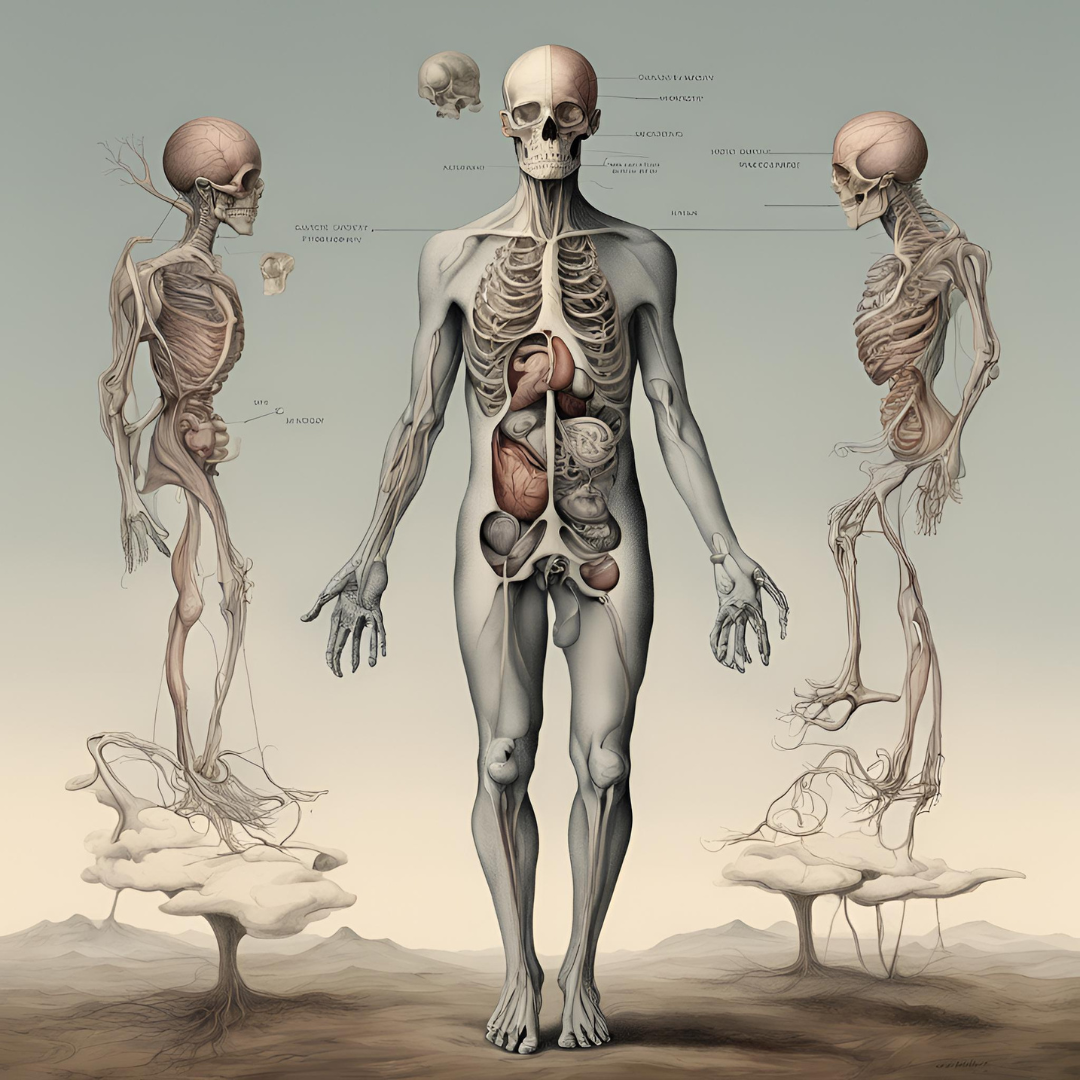
The claim is not that your symptoms are imaginary, that you’re making them up to get attention. It's not that if you simply managed your stress better, your body would fall in line. And it's not that psychological distress is the sole cause of physical illness. The claim is narrower and, I'd argue, more interesting: the body and the psyche are not two separate systems that occasionally cross paths. They are, in a real sense, one system, expressing itself through more than one channel.
What can't be metabolized psychologically—an unspoken grief, a chronic pattern of suppressing your own needs, a long-standing conflict between the life you're living and the life that feels true to you—doesn't simply vanish. It has to go somewhere. The body is frequently where it goes.
This isn't a fringe idea. Contemporary research on the gut-brain axis, the bidirectional relationship between chronic stress and immune function, and the hormonal effects of sustained psychological suppression are all converging on some version of the same picture: your nervous system, your immune system, and your emotional life are far more entangled than the separate specialties of modern medicine tend to acknowledge. None of that makes your symptoms less physically real. It means they may be carrying more information than a purely physical framework knows how to read.
The dream as an unexpected doorway
In my own clinical work, one of the more reliable ways this connection reveals itself is through dreams. People living with chronic physical symptoms often dream in the language of the body—images involving digestion, illness, physicians, or specific parts of the body that mirror where the symptom itself is located. What's striking isn't just the overlap between the symbols in the dream and the physical symptoms. It's that the associations a person has to these symbols—what they actually mean to that person, in their specific history—tend to reveal a connection between the physical and the psychological that neither party expected going in.
There's a nice bit of etymology here worth knowing. The word symbol comes from the Greek symbolon—something that holds two separate things together. A dream symbol involving the body doesn't just point to the physical or just point to the psychological. It holds both at once, which is often the most natural way of understanding why these two dimensions of a person's experience belong to the same underlying story.
Where archetypal traditions and modern research quietly agree
Long before contemporary medicine had language for the gut-brain axis, other traditions had their own ways of mapping the relationship between specific psychological states and specific locations in the body. The chakra system, for instance—understood not as a literal metaphysical claim but as an archetypal map of the body's psychological geography—assigns the throat a very particular significance: the capacity to speak one's authentic truth. Modern endocrinology has, in its own separate and much later way, arrived at something that rhymes with the old tradition: chronic suppression of authentic expression has measurable effects on mood, on stress hormones, and on thyroid function specifically—a gland that sits, of course, at the throat.
Neither framework needs the other's permission to be right. But it's worth noticing when a centuries-old symbolic system and a peer-reviewed endocrinology finding are quietly describing the same territory from two completely different directions. (This is a topic worth its own dedicated exploration—I've written more on the archetypal dimension of the here.)
Returning to the case
It's worth returning to aforementioned client to make the framework less abstract—and to look closely at the timing, because the timing often matters enormously.
The symptoms began at a psychological threshold: the point where "someday, probably" turned into an actual, imminent decision. There was no single dramatic moment to point to, no obvious external event a doctor could ask about. Just a slow shift in the seriousness of the conversation—which, it turned out, was exactly enough to dislodge something that had gone quietly unresolved for a long time.
On the surface, she'd always assumed she wanted children, in the vague, “someday” way most people carry that assumption. What the work eventually uncovered was something she'd never let herself examine directly: she wasn't sure about having kids at all. Was motherhood something she actually, really wanted? Or was it was simply the next expected chapter she'd never really questioned?
Underneath that ambivalence was something more specific. She had spent much of her adolescence as her own mother's closest confidante and emotional stabilizer—the one who managed her mother's moods, absorbed her disappointments, and held the household's emotional weather in a way that was never quite named but was always understood to be her job. The prospect of having a child of her own stirred a fear she could barely articulate, even to herself: that she would either recreate that same fused, boundary-less closeness with her own child, or that she'd overcorrect so hard in the other direction that she'd fail at a kind of closeness she genuinely valued. Both outcomes felt like a kind of doom. Neither felt like something she could say out loud—not to her partner, and not to a mother who had, in her own way, built a significant part of her identity around having raised a daughter who would surely do the same.
None of this was interpreted as the singular cause of her condition, and psychological work like this should never replace medical care. But over the course of the therapy, she became able to name the ambivalence directly and something started to shift. She didn't arrive at a tidy answer right away; if anything, the decision became more consciously complicated before it became clearer. But her digestive symptoms, which had persisted for the better part of a year, eased substantially within a few months of that shift—not because the life decision itself had resolved, but because the truth underneath it was no longer being swallowed in silence.
This is what psychological work can sometimes offer that purely physical treatment can't: not a guaranteed cure, but a way of understanding why now, why this way—and from that understanding, an actual point of leverage that wasn't previously visible.
Toward a more spacious idea of healing
There's a guiding assumption underneath all of this that's worth stating plainly: the mind-body system tends to know how to heal itself, if given what it actually needs. The difficulty is that modern life makes it remarkably hard to know what that is. We're trained to treat isolated symptoms—a pill for the pain, a specific protocol for a specific diagnosis—without asking the more fundamental question of what the whole person, in the whole context of their life, might actually be missing.
Sometimes what's missing is more medical investigation, and this work should never replace that. But sometimes what's missing is something a purely medical model has no real vocabulary for—a creative outlet gone dormant for years, an authentic need that's been chronically overridden, a grief that's never had anywhere to go. Taking the psychological dimension seriously doesn't mean abandoning the physical one. It means widening the lens enough to actually ask what the whole system needs in order to right itself.
If this resonates
If you've spent months or years being told your labs look fine while your body tells a very different story, you're not alone, and there may be more available to you than either "it's psychological" or "it's purely physical" allows for. This is precisely the kind of work I do with clients navigating chronic illness and unexplained symptoms—you can read more about that approach here.
A free 20-minute consultation is a good place to start if you'd like to talk it through.